Wines of Keiliana
Erbesta 14, 231 A.C. (After the Crossing)
By Terna Takveri, Wine Editor
The island of Trinacria was one of the first places that the Noantri landed in the Great Migration. Rather than one built-up terminus for the Great Gate, there were a scattering of outlets, through which came the peoples assigned to this rugged wilderness: first, the Pelasgians, and later, the Keilians. In the first century, even before the official First Coming, the Keilians drove the Pelasgians into the hinterlands and onto the mainland, claiming the best fishing and timber resources for themselves. And they also claimed the best places for vineyards.
The Keilians were one of the least "developed" peoples among the Noantri, with a pre-technological, tribal culture that was organized into large clans and their sub-groups. They were adapted for hunting, fishing, and agriculture, and to the advantage of all of New Earth, they possessed advanced viticultural knowledge as well as vine stock.
The First Comers had already identified several native grape varieties in the area, and the Keilians planted their own on slopes they cleared with their axes and saws and beasts of burden. The Noantri Old World grapes took root and grew in New Earth, and even though they were side by side with the local grapes, their genetics were too different to hybridize. In general the Noantri Old World grapes are much less productive than the cultivated local varieties. In the early decades after the Crossing, you could still find bottles of Noantri Old World wine that had been taken through the Gateway in private collections, and wine explorers documented the comparison between the first Keilian New World vintages and these precious but still drinkable relics from the world left behind.
Nowadays there's no way to tell what those Old World wines tasted like, and the terroir of the New World has forever changed the output of the Noantri Old World vines. But the Keilians, using primitive technology, have managed to produce some of the best wines of the West from their cultivation of the local vines. It's quite a change from the sun-drenched Nilotic wines of the Khemaru, which we are used to finding in inexpensive abundance. Keilian wineries are all owned by families, not government consortia, and if you don't live in or visit Trinacria, it's quite difficult to obtain any of the wines of "Keiliana."
I'll concentrate on one typical red and one white. Probably the most characteristic Keilian red is the "Atra D'Arna" which is named after one of the major winemaking tribes, the Arna. "Atra" means "black" and the native grapes are a pearly black in color. "Atra D'Arna" grows best on the south-facing slopes of the "Sun Coast", in places like Noto and even towards the suburbs of Surakosai. It's worth getting yourself a Keilian guide to venture into the back country to visit the more remote wineries, but you can get a feel for these wines at the more accessible wineries off the Gela Road, the Intermountain Passageway, or even the Catania Coastal Highway.
"Atra D'Arna" is a robust full-bodied wine with a deep blackish-red color. The aroma has a foresty tang and the wine is full of dark fruit and berry flavors with a hint of pine resin on the finish. The Keilians still line some of their barrels with pine resin, though Atra is also available in an un-resinated (and to me, less interesting) version. Atra D'Arna is a perfect companion for roast game such as the wild boar that the Keilians often bring to the restaurants of Surakosai in the fall hunting season.
"Menempsa" is a clear, dry white, again from native grapes. It has a touch of floral aroma and a definite citrus quality but stays dry through the long finish, with a nice herbal underlayer. I'd drink Menempsa with the abundant seafood and fish that our Keilian neighbors harvest from the Middle Sea.
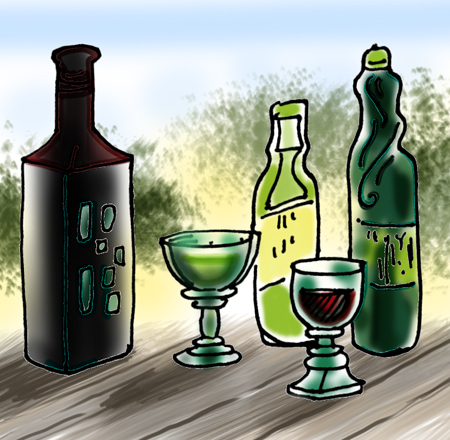
The Keilians may be considered "primitive" by the more urban residents of our island but because they preserve their old technologies, we can enjoy wines that have more individuality and variety, even though they don't travel well. Another benefit of the less-developed tribes is that they produce aesthetically pleasing craft items, especially textiles and hand-blown and shaped glassware. The illustration above shows some of the fanciful wine bottles and glasses made by Keilian craftsmen. Atra D'Arna is often bottled in tall black squared-off bottles with colored glass symbols melted onto the surface.
Around this time, if you go to Keilian wine country, you will see many of the colorful and festive customs that they observe at the harvest and first crushing. You may even see the "wine witch" moving among the wooden barrels and vats, saying her prayers and casting spells. They say that the wine will not ferment correctly without the presence of the proper spells. Nouetic investigators have looked into the process, and have speculated that the "wine witch's" spells induce a micro-telekinetic organic reaction that selects for the desired level of fermentation and yeast growth. Other experts say that the wine witch's work is purely theatrical. I say, as long as the wine is good, let the witch do her work.
Posted at 3:30 am | link
Welcome Back to Surakosai
Racolta 20, 231 A.C. (After the Crossing)
By Kamitria Tiron
It has been a year since this Datachannel has seen a posting. The fireworks of the annual Khemaru end-of-summer festival were last night. Here at Datawell 47, media priorities change, and people's commitments change as well. But life in Surakosai goes on, and we still want visitors to our fair city. The Nouergic Institute still sends out its newsletters, the Keilians continue to wage clan-wars, and the tourists flock here to enjoy the casinos and the seaside resorts. There's plenty to talk about in Surakosai, and plenty to look at, too. So here we are. Have a look at a panorama of Surakosai, sometimes called the "City of Crystal."
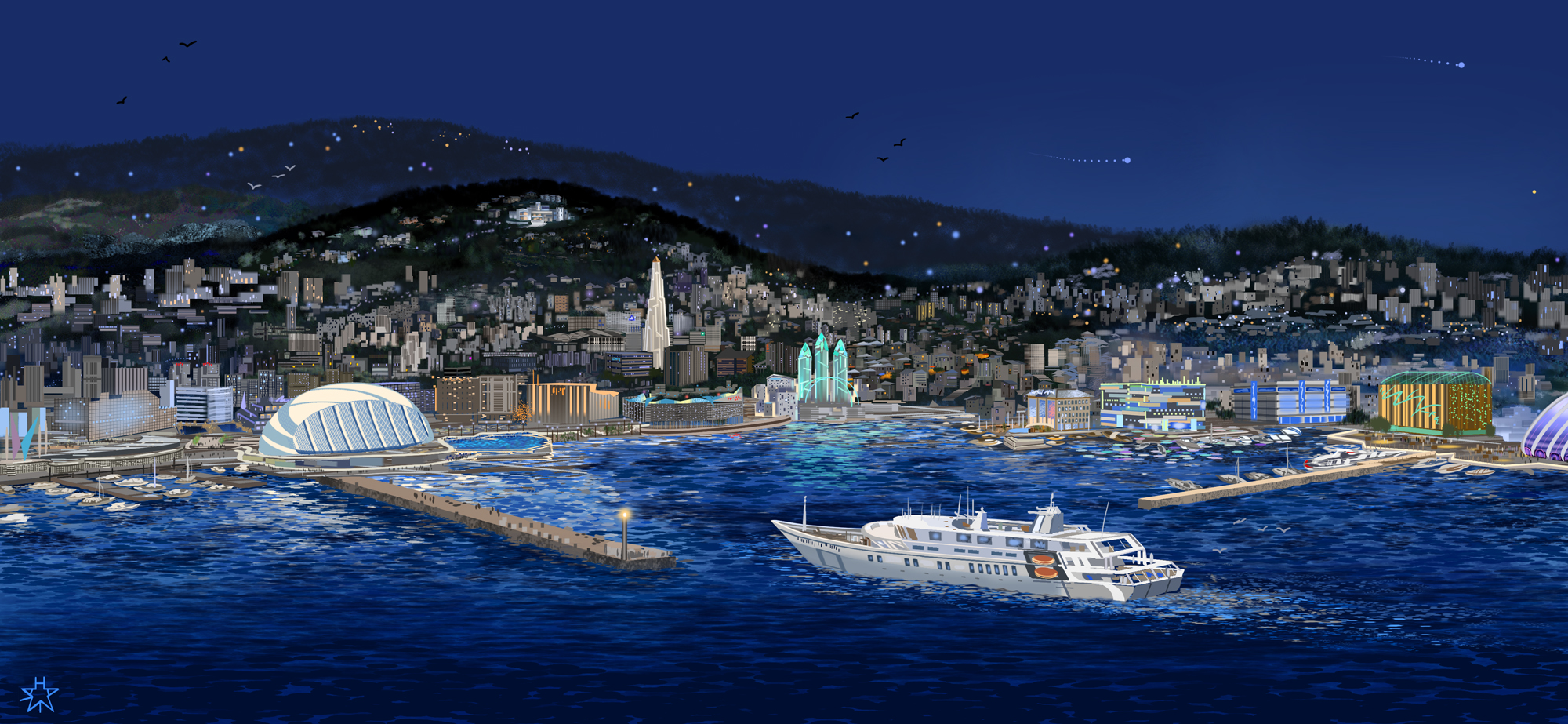
The harbor that you see here, with its glittering entertainment buildings, used to be a simple Keilian fishing village, with a line-up of colorful boats with painted eyes on their prows. You can still see those vessels, but not in the city's "Inner Harbor," which has been rebuilt with casinos and resorts. You can rent a Keilian sailing ship complete with crew, and sail the coastlines as if you were one of the First Settlers, or at least in the first century after the Crossing. But you won't find much good fishing here in the Harbor.
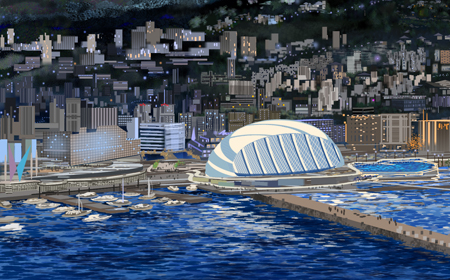
The egg-shaped building you see just at the pier is the Crystal Harbor Convention Center. To the right is the Piscina, or large public swimming pool, which is drained and covered in the winter. Around the Convention Center is the Crystal Harbor resort and casino complex, with room for thousands of people to stay and enjoy life while conventioneering. Recent conventions have included the annual meeting of Aon Aviation corporation (which included an exciting jets-in-formation flyover), the Mesembria Natural Resources Coalition, and the Middle Sea Anthropological Association, whose numbers hardly filled even a quarter of the available space.
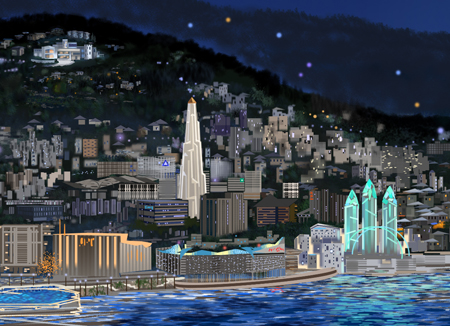
This view features a number of famous buildings in the central part of Surakosai. The tall pointed one in the center is the "Tananoantri Tower," built in the last century by the Tananoantri insurance industry and designed by renowned Khemaru architect Memnon Gebnut. The Tower has 108 floors and is the tallest building on the North Shore of the Middle Sea. It has elaborate earthquake protection and has been through a number of shocks undamaged, including the heptadic earthquake of 215 AC. The three green crystalline buildings are the Aquamarine Plaza, built before the Tower as the first tall buildings in Surakosai. They started as a commercial center but are now equally occupied by cultural groups. Aquamarine Plaza was designed by the theophora architect Apsou-Ari, who later became Head of State in Eridu. It is said that the buildings contain theophoric "retained effects" which cause unusual perceptions among the more sensitive visitors. In the late night, even when the lights are turned off, you might see a mystical glow hovering around the tops of the towers.
Last but not least, up on the hill is the brilliantly lit white complex of the Nouergic Institute of Surakosai. This campus is quite new, fully completed and initiated only about eight years ago. Surakosai has been a center for esoteric Nouergic (theophoric) studies ever since the great nouergist Enlil settled here with his apprentices. His successor, the Khemaru Tanheu, is the current director. The complex was designed by another Nouergist architect, the Khemaru Mereth Kahn. The Khemaru ethnicity has attained an increasing cultural prominence here in Surakosai.
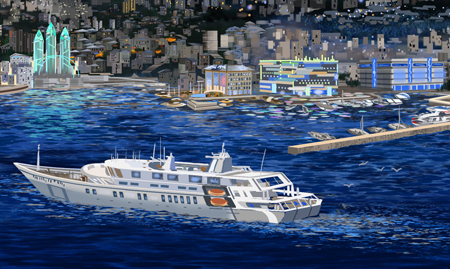
And here is how to arrive at Surakosai in style. This is the cruise ship "Star of the Sea," gliding in to her berth right outside the convention center. The "Star" can only host about fifty elite travelers (and the crew and servants). She makes the voyage between Saida in the Khemaru Levant and Surakosai, about every two weeks during the summer and early fall months. The voyage is truly a luxurious trip, with gourmet food on board and plenty of play, entertainment, and relaxation for the guests. When they arrive at Surakosai they may disembark to stay in one of the resort hotels, or they can use the ship as a floating residence while they tour the city during the day and gamble and attend performances by night. The "Star of the Sea" is maintained by Khemaru, as is her sister ship, the "Star of the East," which keeps to a more Levantine route, stopping at Ionian and Tarsi cities. Just recently plans have been released for two new cruise ships, the "Star of the Night," and the "Star of the Western Horizon," which will be much bigger and able to make transoceanic crossings to the Western Hemisphere.
I hope you enjoyed my pictorial ramble about Surakosai. I will be back, along with my colleagues, to provide bits of interest about our center of civilization here on the shores of Trinacria, the Island of Light. Stay tuned to Datawell 47.

Posted at 1:51 am | link
The Night of the Falling Stars
Racolta 18
By Anjalan Savodra
In Khemi, the land of the Khemaru, it is the national day, September 7 (Racolta 18 in the Noantri common calendar). This day is known as the "Night of the Falling Stars," and it commemorates something which was observed on the Old World of Lanka II, before the Khemaru went through the Gateway to the New World. Around this time each year there was a brilliant meteor shower, and it also coincided with the annual flooding of the great river Yama. The flooding was welcomed because it deposited fertile silt onto the croplands of the Khemaru.
Here on Noantri New Earth the Khemaru occupy a similar habitat, with another river re-named the Yama and more yearly floods. But there is no meteor shower. So the people re-create it with fireworks. The riverbanks of the cities and towns, and the shorelines of the Middle Sea, are all aglow with fireworks displays on the Night of Stars. People turn out in the late summer heat to watch, knowing that the waters will bring new life.

This image shows the newly built port city of Saida, as the fireworks light up the center of the city. There are revelers and observers on the roofs and walkways, and on boats floating in the urban inland waterway.
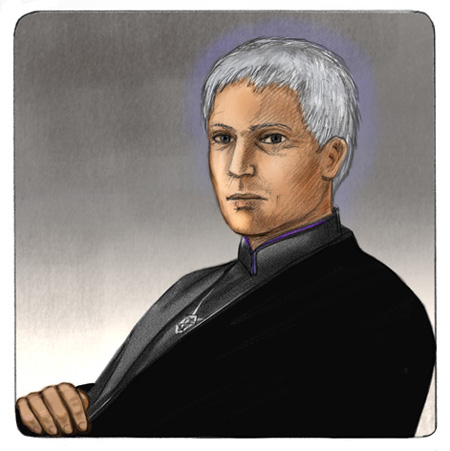
This day also marks the sixtieth birthday of the renowned Khemaru scientist Tanheu Afboureh-Souteth, who re-discovered the scientific basis of techno-magic (nouergy). He had the unusual good fortune to be born on the Night of the Falling Stars. Tonight he is participating in a fireworks display at the University of Masri, where he will create a nouergic lightshow. Happy birthday, Nouergist master Tanheu!
Posted at 2:18 am | link
Mereth Kahn in the ruins
Estiva 4, 230 AC
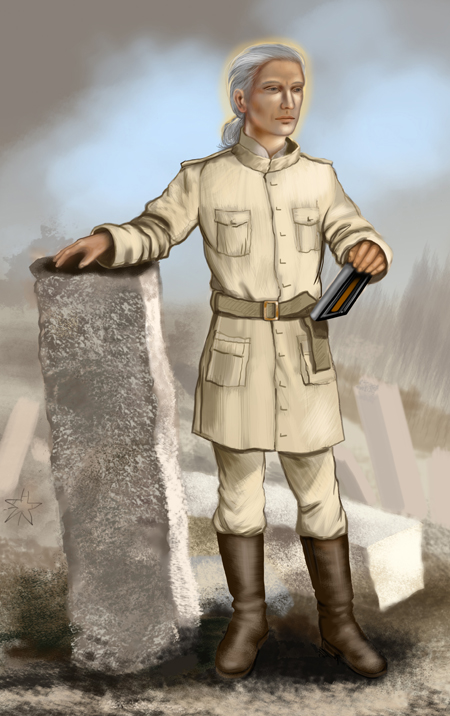
There he was, Mereth Kahn the architect and nouergist, posing for publicity in the ruins of earthquake-stricken Eridu. He came there on his own, attaching himself to the Surakosan relief team, and performed heroically, using his powers to free people who were trapped in debris. But he also has great ambitions for Eridu. The ruined city, which was built with hardly any earthquake resistance, will need to be rebuilt. He intends to be chosen to do as much rebuilding as he can, making his mark as the premier architect of a new Eridu risen from the old ruins.
The last time a Nouergist was an architect, it was the famous Apsou-ari, who became the ruler of Eridu from 140 to 175 AC. The three green crystal buildings at Independence Plaza here in Surakosai are designed by Apsou-Ari. She is probably the greatest female nouergist that has yet appeared on New Earth, and she was Enlil's teacher. Mereth was Enlil's student, in a direct nouergic lineage from Apsou. Unlike Apsou, who knew she wanted to rule Eridu since her youth, Mereth has said he has no political ambitions. He just wants to design and build. He sees Eridu as the perfect place to start over, this time using not only effective modern earthquake resistance but nouergic elements.
He also envisions an Eridu that would supply some of its own power through the use of solar roofs, bio-recycling, and illuminating gas, rather than the oil which is so abundant but so dangerous, or the nuclear power which failed so badly during the earthquake. Everyone who visits Eridu, or wants to move back there and rebuild, knows that a broken nuclear power plant sits on the outskirts of the city, held together only by a nouergic working. Should that fail and release its load of radioactive debris, nothing will help Eridu, not even an ambitious nouergist.
Posted at 2:08 am | link
Archives:
October 2011 (1)
September 2011 (1)
September 2010 (1)
July 2010 (2)
June 2010 (1)
May 2010 (2)
April 2010 (14)
March 2010 (3)
June 2009 (1)
May 2009 (1)
April 2009 (3)
March 2009 (2)
February 2009 (4)
January 2009 (4)
August 2008 (1)
April 2008 (2)
March 2008 (2)
February 2008 (4)